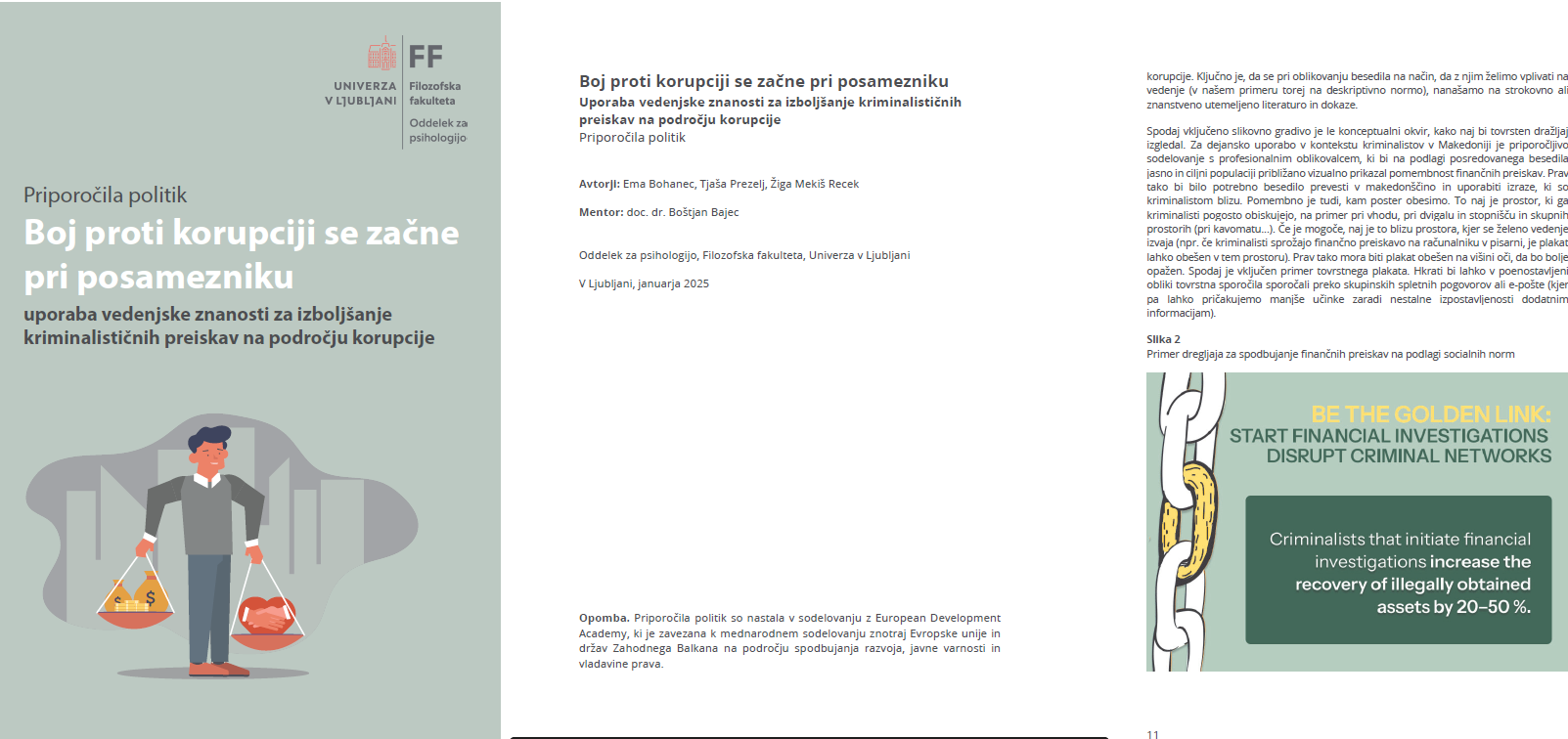
In the 2024/2025 academic year, the European Development Academy cooperated with the Department of Psychology at the Faculty of Arts, University of Ljubljana, in a practice-oriented academic process focused on applying organisational psychology and behavioural science to anti-corruption work in public institutions.
Behavioural and organisational approaches are a regular part of the European Development Academy’s work in integrity and anti-corruption contexts, where implementation depends not only on legal frameworks and policy commitments, but also on everyday decision-making inside institutions. The 2024/2025 cooperation examined this challenge through a structured academic lens.
Under the mentorship of Associate Professor Doctor Boštjan Bajec, a policy-oriented paper was developed by Ema Bohanec, Tjaša Prezelj, and Žiga Mekiš Recek in cooperation with the European Development Academy.
The process combined academic analysis with practice-based insight from institutional environments shaped by procedures, hierarchy, and organisational constraints.
The central focus was the gap between formal rules and routine behaviour. Integrity standards may be clear and widely accepted, yet daily practice is often shaped by workload pressure, established routines, perceived professional risk, and team norms.
The cooperation examined mechanisms such as routine-driven decision-making under time constraints, descriptive and prescriptive norms within teams, and perceived behavioural control in institutional settings.
Particular attention was given to how these factors influence decisions in anti-corruption investigations and integrity-related procedures, where timely action and consistency matter.
The joint process then explored practical, implementation-oriented proposals that remain feasible in real institutions. These included clarifying key decision points within standard procedures, developing simple decision-support tools, and strengthening internal communication that reinforces integrity-oriented expectations.
The cooperation also had a developmental dimension. It linked theoretical knowledge with real challenges in public administration, strengthened analytical and professional skills, and supported young professionals in developing the capacity to design behaviourally informed interventions grounded in ethical and responsible organisational decision-making.
For the European Development Academy, the value of the cooperation lay in the joint applied research process. It translated field experience from anti-corruption work into structured behavioural analysis and practice-relevant proposals aligned with institutional realities, reinforcing an evidence-informed approach to fighting corruption and supporting integrity in public institutions.